


The international bioenergy sector is moving toward structural integration. Laboratory breakthroughs in conversion efficiency now have to align directly with raw material economics, cross-border logistics, and industrial decarbonization targets. For utilities and heat operators cutting carbon emissions, understanding solid bioenergy physics and chemistry - from calorific output to storage stability and ash behavior- is simply a prerequisite for project viability.
To drive international communication and knowledge sharing, Biomass-Events joined the 3rd International Conference on Biomass (Biomass 2027) as an official media partner. Organised by Scisynopsis Conferences, the event takes place June 24 - 25, 2027, in Berlin, Germany. It brings researchers, technology providers, and industry practitioners together for interdisciplinary sessions on biomass tech and renewable energy systems.
Full details on the event agenda, speaker guidelines, and partnership details are available by the link: https://scisynopsisconferences.com/biomass/media-partners/berlin-biomass-conference-signs-global-biofuel-portal-as-media-partner
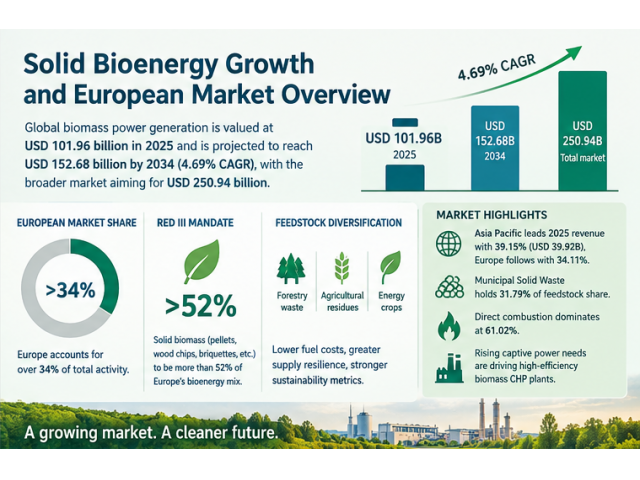
Solid Bioenergy Growth and European Market Overview
Connecting commercial practice with research is central to the Berlin agenda. As European markets navigate RED III updates and supply fluctuations, tying trade statistics and logistics bottlenecks to academic discussions helps operators, traders, and developers apply science directly to daily operations. The numbers tell a clear story: with global biomass power generation valued at USD 101.96 billion in 2025 and heading toward USD 152.68 billion by 2034 (4.69% CAGR) - and the broader market aiming for USD 250.94 billion - grounding research in market metrics is an operational necessity.
Global biomass power and solid fuel markets are expanding, with Europe accounting for over 34% of total activity. Mandates under the EU Renewable Energy Directive (RED III) push solid biomass - industrial wood pellets, agri-pellets, wood chips, and briquettes - to more than 52% of Europe’s bioenergy mix.
Feedstock portfolios are also diversifying. Industrial users are adding agricultural residues and energy crops to traditional forestry waste. The goal is straightforward: lower fuel costs at the gate, build supply resilience, and hit sustainability metrics.
Market Highlights & Trajectory:
- Market Expansion: Bioenergy generation continues a 4.69% annual growth trajectory through 2034, pushing the broader sector toward the USD 250 billion mark.
- Regional Distribution: Asia Pacific led 2025 revenue with 39.15% (USD 39.92 billion), while Europe closely followed at 34.11%.
- Fuel & Tech Preference: Municipal Solid Waste holds 31.79% of feedstock share. On the technology side, direct combustion remains dominant at 61.02%.
- Industrial Demand: Rising captive power needs in processing industries are driving rapid adoption of high-efficiency biomass Combined Heat and Power (CHP) plants.
Linking Academic Research with Supply Chain Realities
For solid fuel producers, merchants, and plant managers, commercial reality is set well before fuel enters the boiler. Moisture content, particle size, mechanical durability, and ash behavior dictate pricing, transport options, and boiler setup.
Through this partnership, Biomass-Events links lab work in Berlin to actual plant floors. Sharing data on thermochemical conversion, processing techniques, and feedstock characteristics gives market participants direct access to evidence that improves efficiency, standardizes fuel grades, and strengthens cross-border trade networks.